
SERVICES

TPI uses the TPI Outsource Value Framework™ detailed below, in assisting clients to:

  • Prepare the business case for outsourcing;
  • Select an outsource partner;
  • Negotiate the outsource contract including SLA’s; and
  • Put in place the performance management and governance frameworks to manage outsource performance.

The business case is the common thread throughout the process and is constantly updated with new information and re-evaluated at each stage of the process to ensure that the business case for outsourcing remains valid. The above process ensures that:

  • The outsource partner selected is the one that can deliver the maximum business value to the client.
  • The vendor evaluation criteria are built around the key business drivers.
  • The contract is negotiated around the key business drivers, which form the basis for the SLA (service level agreement).
  • Delivery against the business case is managed via the performance management framework which mirrors the SLA’s and therefore the key business drivers.

TPI believes in negotiating win-win contracts that are fair to both client and service provider, as this ensures a partnership based relationship that is sustainable.  Strong contract governance and performance management is built into the process to ensure expectations are clear and performance is explicitly and rigorously managed.  In addition the contract is constructed in a manner to ensure flexibility to cater for changing business needs, priorities, and scope.  This is achieved by separating the legal and business terms (service model and levels) so that changes to the business terms can be applied without requiring changes to the core legal contract.

The TPI Outsource Value Framework™ together with TPI’s experience ensures that:

  • The outsource approach is aligned to the business strategy.
  • The SLA’s are aligned with the business drivers and performance is managed against this.
  • Expectations, scope, and responsibilities are all clearly understood.
At TPI we work both with our clients and with market service providers in ensuring the structuring of technology and outsourcing relationships that are both successful and sustainable. This applies both to the development of new relationships as well as the remediation of existing relationships that have either been unsuccessful or need to be adapted as a result of changed business drivers or market conditions.

TPI uses the TPI ICT Value Framework™ to ensure successful value delivery by providing input from the development of the required business case, the underpinning strategy, the project plan and thereafter managing the project through to completion.

The assessment and restructuring of ICT service contracts is a core TPI competence which has been instrumental in significant cost savings and service delivery improvements across multiple industries. The approach and model developed and used by TPI is represented below.

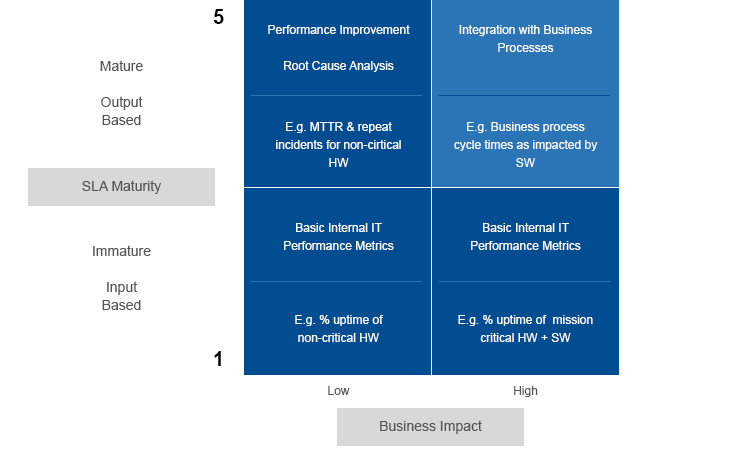
In order to ensure that the delivery of business value is enhanced through effective service management, it is critical that service levels are not static. They but must be able to reflect and incorporate changes in business strategy, market conditions and operational processes and procedures. The SLA Maturity Matrix is used to assess the current level of SLA maturity and to develop a blueprint for moving the measurement framework from the current state to the desired state.

As such, it is critical that a review process is in place to objectively rate and understand how well designed and constructed the current SLA framework, and how well it reflects the business strategy and objectives. The key challenge is to ensure that an organisation is moving from measuring performance of IT components in IT terms to measuring business impact in business terms while adopting a continuous improvement framework.  

The TPI SLA maturity matrix is shown below:


On the other hand, we denounce with righteous indignation and dislike men who are so beguiled and demoralized by the charms of pleasure

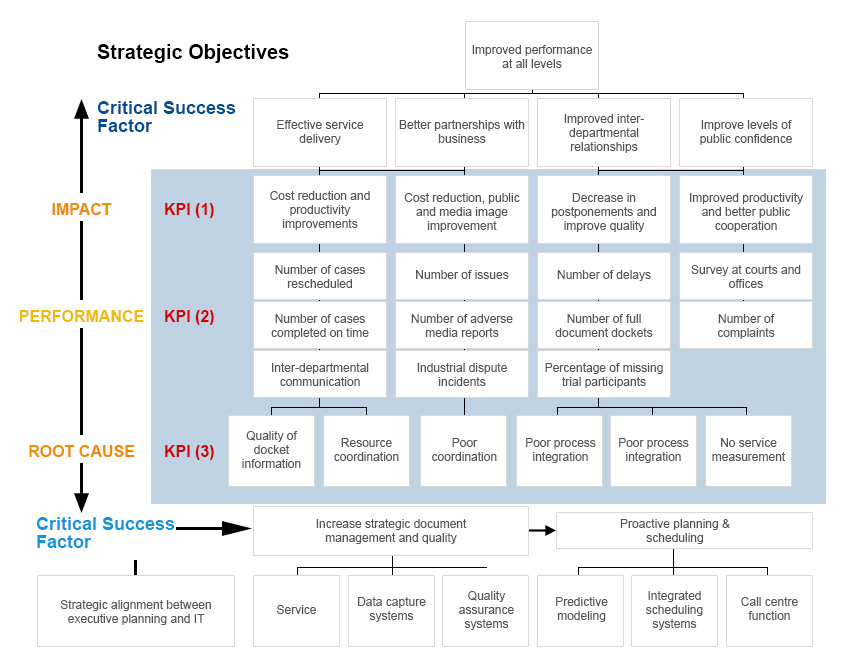
We work very closely with our clients to understand the links between the impacts of ICT delivery on the achievement of strategic objectives through a process of designing functional relationship models. These models provide a clear hierarchical representation of the cost and value drivers within a particular process or function. The net result is the ability to clearly understand and measure the cost and value relationships between IT and operations, and the subsequent impact on the achievement of key business goals.

The outputs from this exercise are then used as the inputs to the design, development and implementation of a performance dashboard and/or balanced scorecard.

An example of the type of a functional decomposition model is shown below.


TPI has worked closely with a number of major South African and international corporations to assist them in developing and managing their ICT governance programmes. The objectives from a project of this nature are to ensure that:

  • There is strong alignment between business and ICT.
  • Business is able to measure the ICT value contribution.
  • Risks are managed appropriately.

In order to achieve this, TPI provides the following services:

  • The design and implementation of proven ICT Governance processes and disciplines are a key component of this service offering.
  • The provision of outsourced CIO role, either on a full-time or a part-time basis dependent on the requirements of the client organisation.

The current economic and business drivers have helped to create a market climate favourable to M&A activity. At TPI, we apply models and methodologies, underpinned by our extensive market experience to provide operational due diligence services to our customers and to private equity funds.

The driver of the TPI approach is to ascertain whether the target organisation has sustainability in terms of revenue, profitability, market approach and customer base. TPI works in conjunction with audit firms carrying out traditional financial due diligence and provides strategic input into determining the current and future viability of the target organisation.

TPI has a great deal of experience in providing programme management services covering:

  • Implementation of ICT Services and Systems procured by clients, thereby ensuring that the chosen vendor delivers according to the contract and the client’s expectations.

Implementation of programme and project management processes and tools that can be deployed at clients.  This includes knowledge transfer to and coaching of client staff to make them self sufficient.